About Organ Pipes National Park
Organ Pipes National Park is a 152ha large protected area in Keilor, Victoria, about 23km north-west of Melbourne, Australia. The park was established in 1972 on what was at the time, degraded farmland around a gully created by Jacksons Creek. The aim was to try to re-establish the native vegetation of the district, which was quickly becoming scarce due to urban development and farming in the region. The site was chosen because it is home to several very interesting geological features, most notably, the 'Organ Pipes', which are vertical pipe-like rock structures that resembled organ pipes, hence the name. These basalt columns, formed by lava flows are the central feature of this park in a deep gorge in the bare Keilor plains. The organ pipes were formed about a million years ago when a lava flow, approximately 70m thick spread over the plains from an eruption from Mt Holden and the nearby volcanic hills. The liquid rock filled all the valley and depressions in the land at that time and formed a basalt plain. A surface crust formed and the lava below this hardened crust began to cool very slowly and contract. Vertical surface cracks began appearing and as the lava continued to cool, harden and contract, the cracks lengthened until the basaltic mass was split up into the columns we can see today. Over the next one million years, Jacksons Creek cut a deep valley eroded a deep valley through the basalt layer (which had been covering the organ pipes) to expose the organ pipes. Other geological features present in the park include the Tessellated Pavement, the Rosette Rock, Scoria Cone and the Sandstone Bedrock. The valley floor about 250m upstream of the Rosette Rock is a basalt outcrop whick has a mosaic-like appearance, hence giving it the name 'The Tessellated Pavement'. It is another basalt rock form, but instead of the vertical faces of the columns, the basalt is horizontal - you can walk and climb on them. This structure was formed when water eroded many of the basalt columns. Five hundred metres upstream of the Organ Pipes is a large outcrop of rock that overhands the northern bank of the stream. It sports a radial array of columns resembling the spokes of a wheel. The Rosette Rock was formed by a pocket of lava cooling, probably in a spherical formed by an earlier lava flow, which caused the lava to dry in a radial pattern. The Organ Pipes National Park car park is actually built on the remains of a very weathered scoria cone. Around 800,000 to a million years ago, larger volcanoes to the north of the region ejected molten rock and lava in a series of volcanic explosions, producing scoria cones, which are a rock structure, brownish in colour and filled with air pockets. The rock is very light weight because of these air pockets, which are formed when steam is issued out of a volcanic eruption. Fossils, which can be found in the park's sandstone sedimentary rock near Jacksons Creek, date back about 400 million years, indicating that the sea once covered this region. When early European settlers settled, they vigorously farmed the land, and combined with urban developement, these activites destroyed the land and endangered many indigenous species of both flora and fauna. In the years since these disruptive activites, the park has been re-established to its natural beauty. |  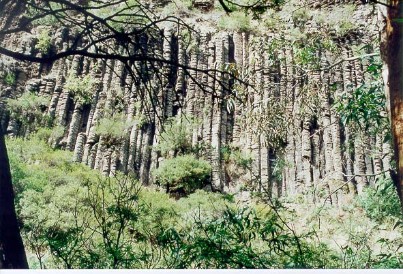 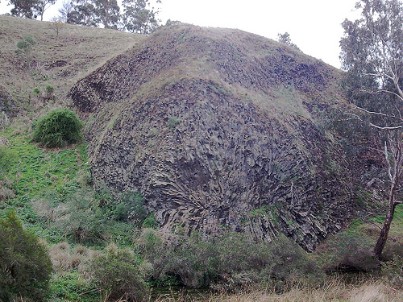  |
